
From the Ground Up: Deep Foundations
Strong foundations start deep below the surface.
When Deep Foundations Are Needed
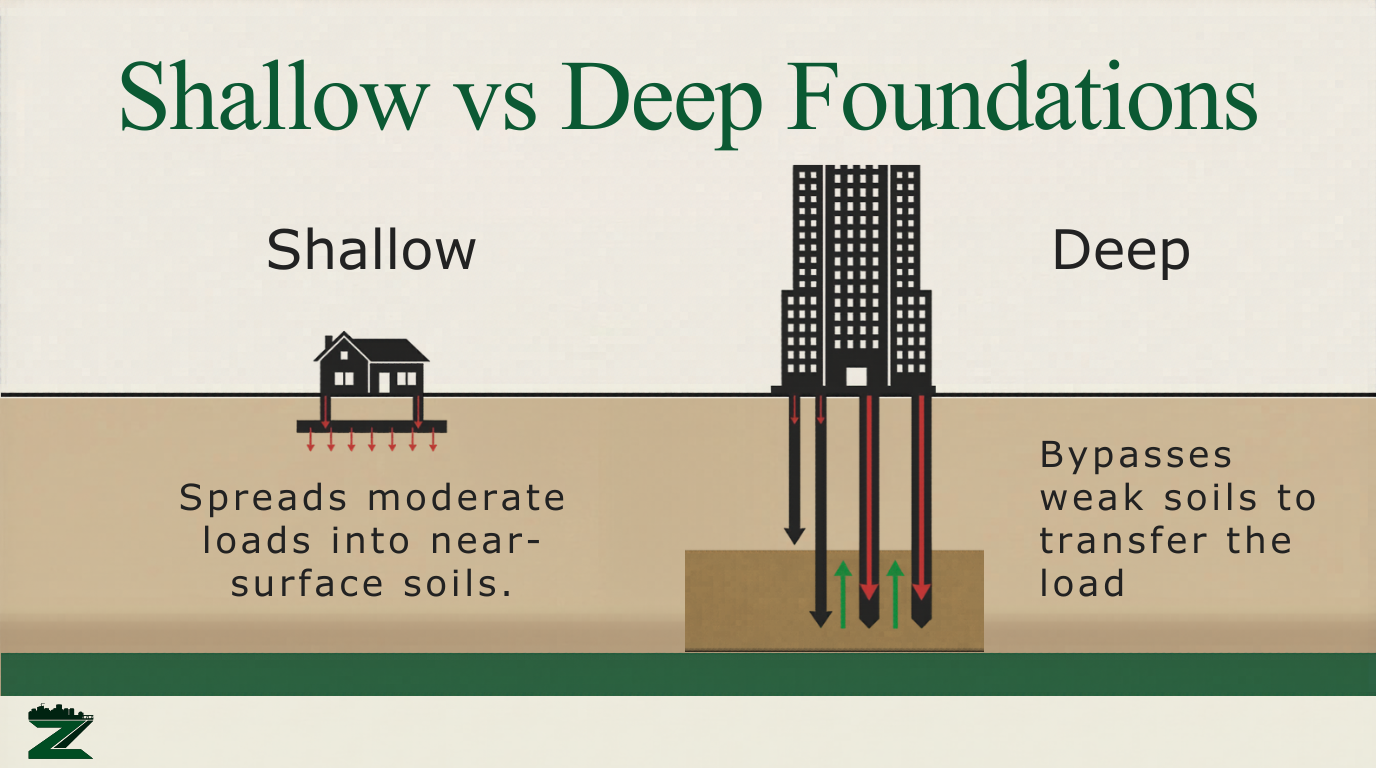
Sometimes the existing soils on a project are not capable of supporting the desired weight of a structure. This can be due to poor soil conditions, existing undocumented fill or structural loads that exceed the bearing capacity of the soil.
When a deep foundation system is required to support a building, it’s important that the system is appropriate for the site conditions and installed correctly. Rather than relying on near-surface soils, deep foundations transfer loads to stronger material at depth.
Common Types of Deep Foundation Systems
Common deep foundation systems include:
- Driven piles — long elements installed into the ground to transfer load through the soil
- Drilled shafts (caissons) — larger diameter elements constructed in place for heavier loads
Before driving piles, most projects require verification that they can handle the loads. This is typically done through:
- Static pile load testing — applying weight to a test pile to confirm how much it can support
- Dynamic evaluation methods — analyzing how the pile and surrounding soil respond during installation
How Deep Foundations Are Tested
One common analytical approach, often referred to as a wave equation analysis, models how energy is transferred through the pile and surrounding soil to estimate how much load the pile can safely carry. During installation, tools like a Pile Driving Analyzer (PDA) measure how the pile responds in real time, helping confirm that it is performing as expected.
Throughout installation, pile driving logs are kept continuously. Our staff record each pile’s placement, depth, and performance, and summarize this information in daily reports. This provides a clear record of the work and confirms that the piles meet project requirements.
Monitoring pile driving ensures the foundation is built correctly, helping the structure be supported safely and reliably. Accurate testing and documentation help prevent problems and give everyone confidence as construction moves forward.
Come Build on Our Foundation
From the Ground Up is a series exploring the engineering and materials testing processes that support safe construction across Central Virginia.
Explore more in the series